Terminology
Terminology: Disease Outbreak
The terms below will help you understand terms used to describe quarantine and movement control measures that may be needed to contain the pathogen for eradication.
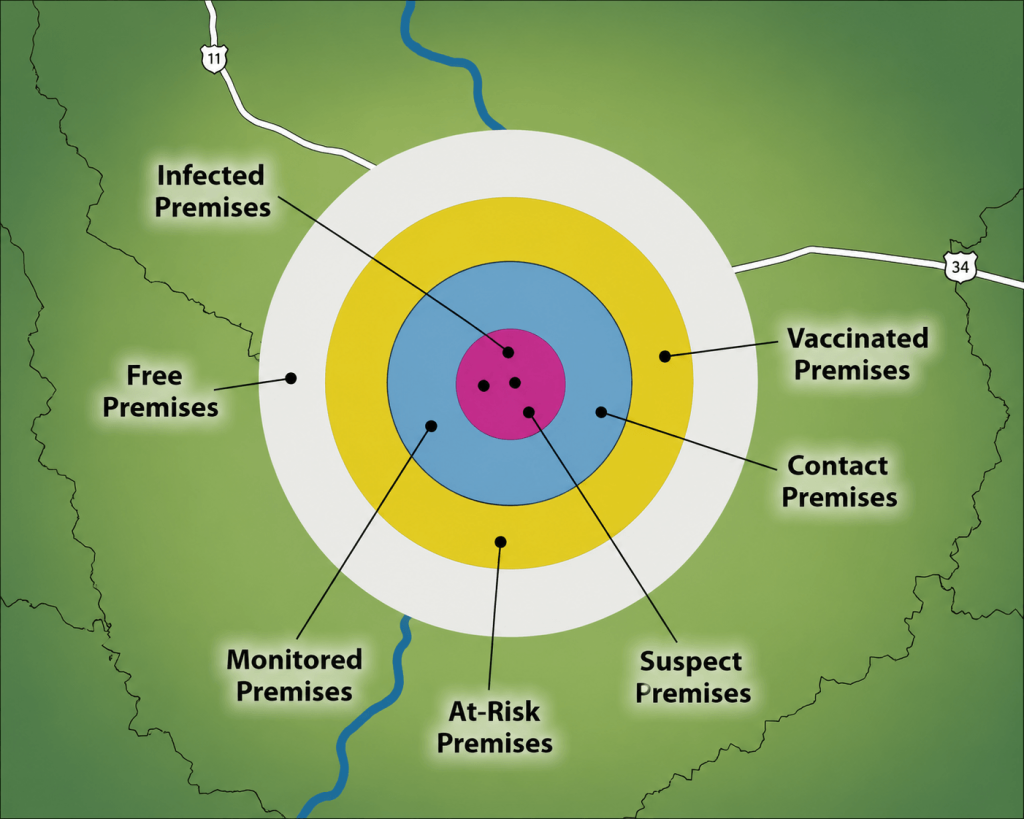
- Infected Premises- Location where a presumptive positive case or confirmed positive case exists
- Movement of animals, animal products and fomites onto, out of, or within an Infected Premises prohibited – unless a specific permit (approved by Incident Command) and appropriate biosecurity measures are used
- Contact Premises- Location with susceptible animals that may have been exposed to the foreign animal disease, either directly or indirectly
- Movement of animals, animal products and fomites onto, out of, or within an Contact Premises prohibited – unless a specific permit and appropriate biosecurity measures are used
- Suspect Premises- Location under investigation due to the presence of susceptible animals reported to have clinical signs compatible with the foreign animal disease
- Temporary designation pending investigation
- Movement of animals, animal products and fomites onto, out of, or within a Suspect Premises prohibited – unless a specific permit and appropriate biosecurity measures are used
- At-Risk Premises- Locations with susceptible animals; however, none of these animals exhibit signs compatible with the foreign animal disease
- Movement of animals, animal products onto, out of, or within an At-Risk Premises may be allowed with proper biosecurity measures; a permit may be required
- Monitored Premises- Location that has objectively demonstrated they:
- Do not have a positive case of the FAD, or
- Do not have susceptible animals that have been exposed to or exhibiting clinical signs compatible with the FAD
- Movement of animals, animal products, and fomites into, out of, or within Monitored Premises will be allowed but may require a permit and proper biosecurity practices
- Vaccinated Premises- Area where emergency vaccination has been performed
- Free Premises- Sites outside the Control Area that are not considered an Infected, Contact, or Suspect Premises
- Movement of animals, animal products, and fomites into, out of, or within Free Premises will be allowed but may require a permit and proper biosecurity practice
- Quarantine Areas – Quarantine area will be determined by many factors, including jurisdictional areas, physical boundaries, epidemiology, environment (e.g., climate), and characteristics of the designated premises and response zones.
- Control Area- Consists of the Infected Zone and the Buffer Zone
- The perimeter should be at least 10 kilometers (~6.21 miles) beyond the perimeter of the closest Infected Premises
- Boundaries can change as the response proceeds
- Free Area- Area that is not included in the Control Area
- Control Area- Consists of the Infected Zone and the Buffer Zone
- Quarantine Zones- The size of the quarantine zones will be determined by many factors, including jurisdictional areas, physical boundaries, disease epidemiology, environmental factors (e.g., climate), and characteristics of the designated premises.
- Infected Zone- The area that immediately surrounds an Infected Premises.
- The perimeter of this zone should be at least 3 kilometers (~1.86 miles) beyond the perimeter of the presumptive or confirmed Infected Premises.
- Exact distances will depend on the disease agent present and epidemiological circumstances.
- The Infected Zone boundaries may be redefined as the response efforts progress.
- Buffer Zone- Area that immediately surrounds the Infected Zone or a Contact Premises.
- The perimeter of this zone should be at least 7 kilometers (~4.35 miles) beyond the perimeter of the Infected Zone.
- This zone may also be redefined as the disease outbreak response continues.
- Surveillance Zone- Zone outside of and along the border of the Control Area.
- The perimeter should be at least 10 kilometers (~6.21 miles) wide
- Vaccination Zone- Classified as either a Containment Vaccination Zone or a Protection Vaccination Zone based on the goal of the vaccination activities
- A Containment Vaccination Zone is typically found within the Control Area
- A Protection Vaccination Zone is typically found outside the Control Area.
- This zone designation can be secondary with another zone designation
- Infected Zone- The area that immediately surrounds an Infected Premises.